
Scientists create stunning, non-fading paint without a single pigment
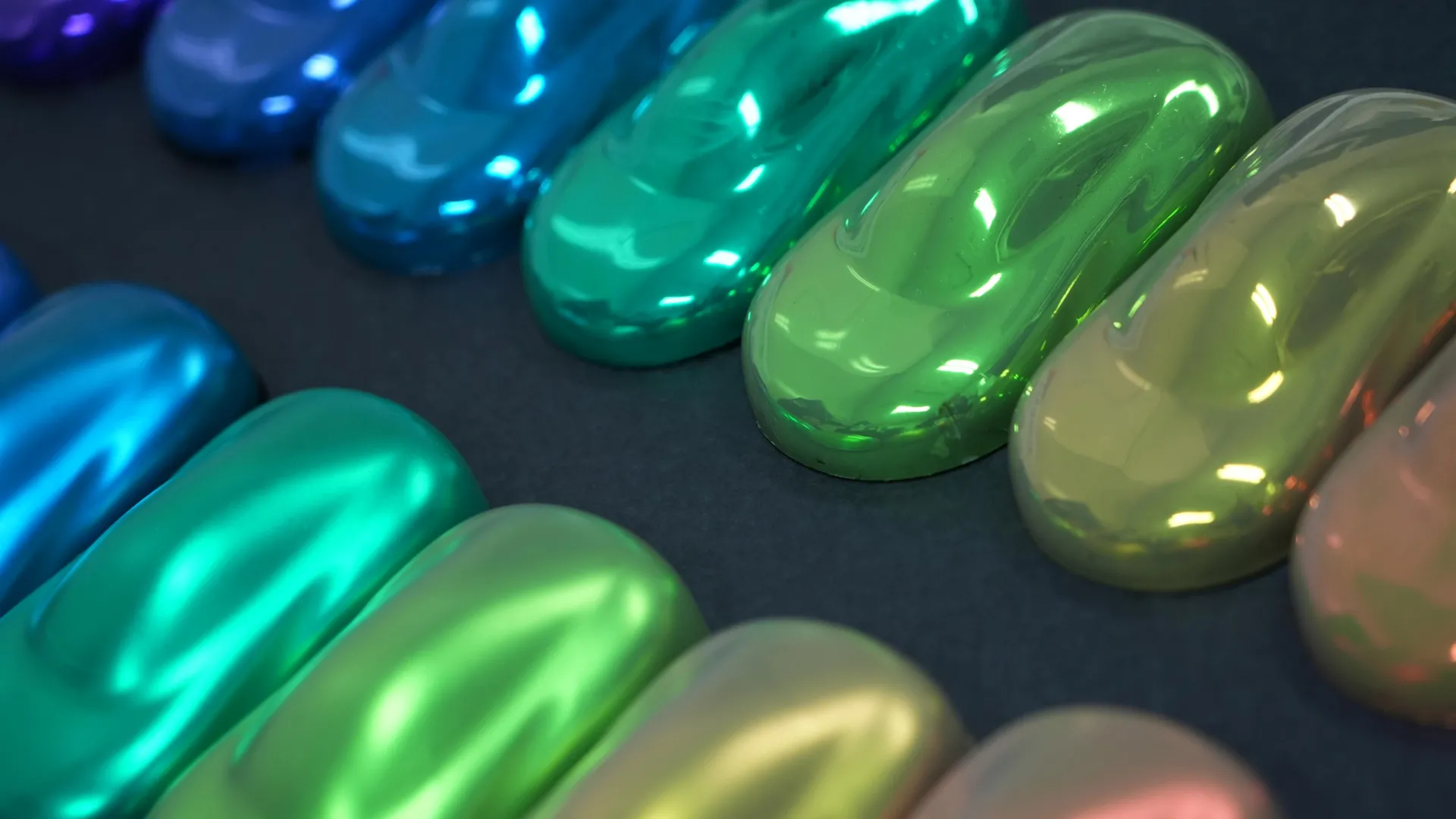
Researchers at Kobe University have developed a coating that produces the rich colors and glossy finish of automotive paint without relying on pigments. The breakthrough overcomes several major limitations of structural color, making it possible to apply colors that resist fading to large, complex surfaces, maintain a consistent hue from different viewing angles, and add protective coatings.
"Color coatings are expected to provide vivid color, brightness, gloss, and long-term durability, yet no existing technology satisfies all of these requirements simultaneously," says Kobe University materials engineer Hiroshi Sugimoto.
Traditional paints typically require relatively thick layers of pigments, which add considerable weight and can fade over time. Structural color, a phenomenon responsible for the brilliant appearance of peacock feathers, offers an alternative that avoids the fading caused by light exposure in organic pigments. However, conventional approaches to structural color require precisely arranged microscopic structures, often produce different colors depending on the viewing angle, and are incompatible with protective coatings.
Unlocking Glossy Color Without Pigments
Sugimoto previously pioneered a new method of producing structural color using tiny silicon spheres that generate consistent colors regardless of viewing angle. His team subsequently adapted the technology for inkjet printing (link). Although the resulting coatings produced color successfully, they scattered reflected light in multiple directions, leaving their surfaces without a glossy finish. The technique that made inkjet printing possible, however, also provided a potential solution to this problem.
Sugimoto explains, "Packing the nanospheres in silica shells not only protects the particles but also controls their spacing and should improve self-assembly into neat arrays." Arranging the particles more uniformly reduces the scattering of reflected light, allowing the coating to develop a glossy appearance.
In a study published in the journal Small Structures, the researchers demonstrated that they could produce and adjust the gloss of structural color coatings on large, three-dimensional surfaces. They also found that applying a protective layer had little effect on the resulting color.
"The most exciting aspect of this work is that it demonstrates glossy, non-iridescent and protection-coated structural color coatings for 3D objects in a single platform, making the technology useful for real-world applications," explains Sugimoto.
Ultra-Lightweight Paint Could Transform Aviation
One of the technology's most remarkable advantages is its extremely low weight. A single layer of silicon nanospheres is sufficient to produce bright colors with high opacity, effectively concealing the underlying surface.
The potential weight savings are particularly striking for aviation. Conventional coatings on wide-body airliners currently add several hundred kilograms to the aircraft's weight. The researchers estimate that a color coating based on their technology could weigh only several hundred grams, less than a carton of milk for an entire airplane.
The materials used to create these coatings also offer environmental advantages. Silicon is nontoxic and can be sourced from the semiconductor industry, while silica is among the most abundant materials in Earth's crust. Combined with their resistance to fading, the minimal material requirements could make future color coatings significantly less resource-intensive.
Taking Structural Color Beyond Paint
Sugimoto is helping establish a company to increase production and bring the technology to industrial markets. The coating process is particularly promising because it can be integrated into several established manufacturing techniques.
"The process is compatible with scalable coating methods such as spray coating, slot-die coating, and roll-to-roll processing."
Beyond commercial paint applications, Sugimoto hopes to use the underlying science to create advanced coatings that perform multiple functions. Future versions could combine vivid structural color with capabilities related to sensing, light-driven chemical reactions, and energy management.
He says: "We want to expand the possibility of applications for the science behind our technology beyond coloration. Looking ahead, we aim to develop multifunctional silicon nanoparticle coatings that combine structural coloration with additional optical functions such as sensing, photocatalysis, and energy management."
This research was funded by the Japan Agency for Medical Research and Development (grants JPMJPF2503, JPMJSF2405) and the Japan Society for the Promotion of Science (grants 24KF0158, 24K01287, 24K22206, 25K01608).
Comments 0
Leave a Reply
Your email address will not be published. Required fields are marked *
Science
Explore All
Scientists may have discovered the hidden root cause of allergies
Scientists are challenging decades of medical thinking with a surprising hypothesis that allergies may begin with an energy failure inside the body's...
Yale scientists may have found a shortcut to the anti-aging benefits of eating less
1 hour ago
Scientists create stunning, non-fading paint without a single pigment
1 hour ago
New once-daily pill slashes “bad” cholesterol by up to 65%
5 hours agoTwo overlooked “forever chemicals” linked to up to 2.5 times the odds of liver cancer
9 hours agoWhats New
View All
Sakana AI’s CEO says its homegrown models are about more than Japan’s national security

Planning a Holiday Trip to New York City? These Hilton Hotels Put You Steps From the City’s Most Festive Attractions
Scientists may have discovered the hidden root cause of allergies
Yale scientists may have found a shortcut to the anti-aging benefits of eating less

Iran points to Europe’s war role after Italians killed in Kuwait strike
Scientists create stunning, non-fading paint without a single pigment

Court rejects Argentina’s request to stop UK oil activity near Falklands

Bootleg alcohol poisonings in Iran see dozens dead and badly injured

Mamdani eyes 2028 kingmaker role as expert warns socialist movement could gain power even in defeat
