
New NASA Seed Funding Primes Small Businesses for Innovation
Awards to small businesses around the country are addressing some of NASA’s most crucial technology needs for exploration of the Moon and Mars while fueling the U.S. space economy.
NASA’s Small Business Innovation Research/Small Business Technology Transfer (SBIR/STTR) program recently selected 302 innovative projects, for a total investment of up to $171 million in seed funding.
This early-stage research and development work will tackle an array of topics, including those related to Artemis and the establishment of a U.S. Moon Base. Selected projects include next-generation battery solutions, robotic systems with sensing capabilities for the extreme lunar environment, and tools to prepare for construction of critical infrastructure, such as lunar landing pads.
NASA’s SBIR/STTR program provides support for entrepreneurs, startups, and small businesses to advance and commercialize technologies that can advance the agency’s missions. Working with the program, a company’s path toward commercialization or infusion into NASA missions occurs in phases. The latest awards involved two of these phases.
The new Phase I contracts will receive up to $225,000 each to establish the merit and feasibility of their proposed innovation. A portion of the projects selected are STTR awards, provided to small businesses partnered with research institutions.
The Phase II awards, with 98 contracts valued at up to $1.3 million each, will continue work begun in Phase I projects selected in 2025, targeting demonstration and delivery of the innovative technologies.
Following are a few examples of research supported through these recent awards:
- Bringing Power to Moon and Mars
An SBIR Phase II award for Opterus Research and Development Inc. supports a project focused on bringing power to the surface of the Moon and Mars by developing a modular system of rollable solar arrays. The arrays can be handled robotically, are compatible with various support structures, and work even in dusty surface conditions. The technology could be scaled up to 50 kilowatts, and it could provide a reliable power source to help both NASA and commercial space companies develop infrastructure on the Moon.
- Rovers With Reach: Vision and Tactile Sensing in Robotic Arm
This SBIR Phase I award, led by Intelligent Fiber Optic Systems Corporation, aims to help lunar rovers perform complex tasks independently on the Moon. The firm’s 10-foot, extendable robotic arm can both “see” and has a sense of touch, combining a camera with sensors to detect and measure surface textures, contact forces, and temperature. The technology could help automate many lunar surface tasks, such as cleaning solar panels, positioning habitat structures, and collecting scientific samples from hard-to-reach locations. On Earth, the same instrumented robotic arms could be used to inspect and repair power lines, nuclear reactors, or other infrastructure in hazardous environments.
- Cold-Friendly Battery for Long Lunar Night
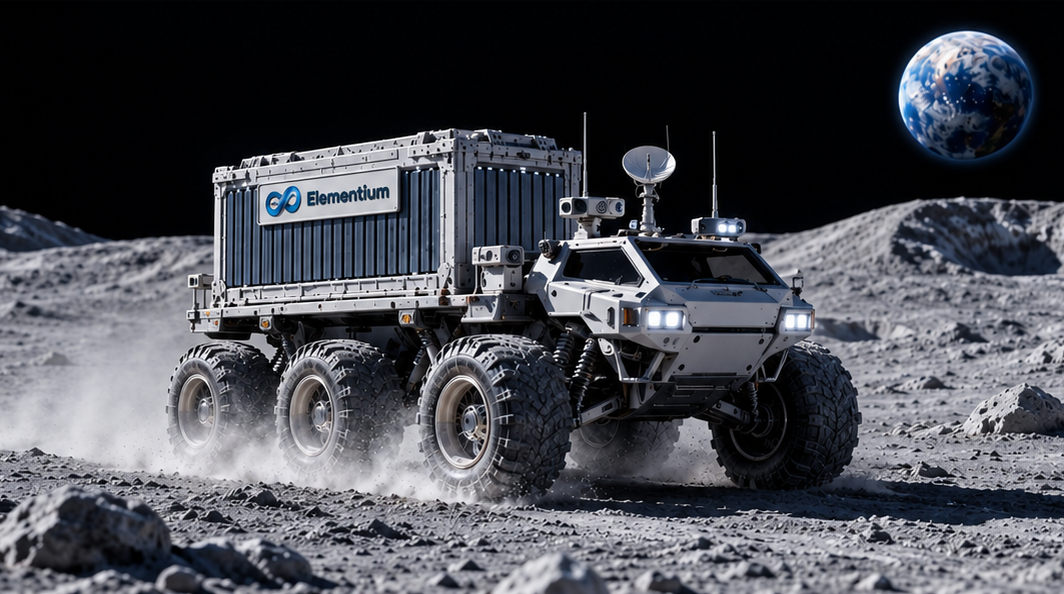
Elementium Materials Inc., selected for an SBIR Phase I award, is developing an ultra-cold-tolerant battery module for space applications and cold-climate uses on Earth. The technology can operate down to minus 76 degrees Fahrenheit without active heating, reducing the need for heaters and insulating layers to work on the Moon. With the space and mass that’s saved, NASA missions can launch other tools and science experiments, instead. This battery technology could help keep rovers, habitats, and other infrastructure running through the frigid, 14-day lunar night and potentially on Mars.
- Prepare for Landing — Repeatedly — on Moon
A collaboration between Slate Geotechnical Consultants Inc. and the Colorado School of Mines will evaluate two approaches to preparing lunar regolith for repeated lunar landings, so that routine mission activities can have sturdy, reusable landing pads. Without such pads, the force generated by a rocket can blast out loose, gravel-like regolith from the surface, throw up dust, or create craters, potentially damaging spacecraft and nearby infrastructure. The project, supported by an STTR Phase I award, will also investigate ways to use rovers to repair and maintain future lunar landing pads.
Complete lists of the selected proposals are available on the SBIR/STTR program’s website:
Phase I:
- 2026 NASA SBIR Appendix A Phase I
- 2026 NASA SBIR Appendix B Phase I
- 2026 NASA STTR Appendix B Phase I
Phase II:
NASA’s SBIR/STTR program is part of the agency’s Research and Technology Mission Directorate and is managed by NASA’s Ames Research Center in California’s Silicon Valley.
Comments 0
Leave a Reply
Your email address will not be published. Required fields are marked *
Science
Explore All
A simple metal is hiding a strange new form of magnetism
Scientists have discovered a strange form of magnetism in an ordinary-looking metal that has no overall magnetization yet profoundly changes how elect...

2,200-year-old Roman shipwreck reveals an ingenious waterproofing trick
2 hours ago
Cannabis users develop psychosis years earlier, and the gap grows with age
2 hours ago
Scientists discover a new type of depression that common antidepressants struggle to treat
2 hours agoEarth's next ice age may have already begun. Global warming stopped it
3 hours agoWhats New
View All
‘GTA 6’ Is a Birder’s Paradise

Best Early Black Friday AirPods Deals (2026)

Why is GTA 6 Getting Review Bombed?

The ‘eighth front’: Why Israel’s influence war in the US is failing

The Best Early Black Friday MacBook Deals (2026)

Now There’s a GLP-1 in Chocolate Form

Why are Russian warships off Libya, and will Ukraine’s attack change that?

GTA 6 Hacker Releases Full Xbox Build, And PC Modders Are Already Trying To Get It Running

Iraq orders takeover of oilfields in areas under Kurdish control
