
New Album of Baby Star Sounds Shared by NASA’s Chandra
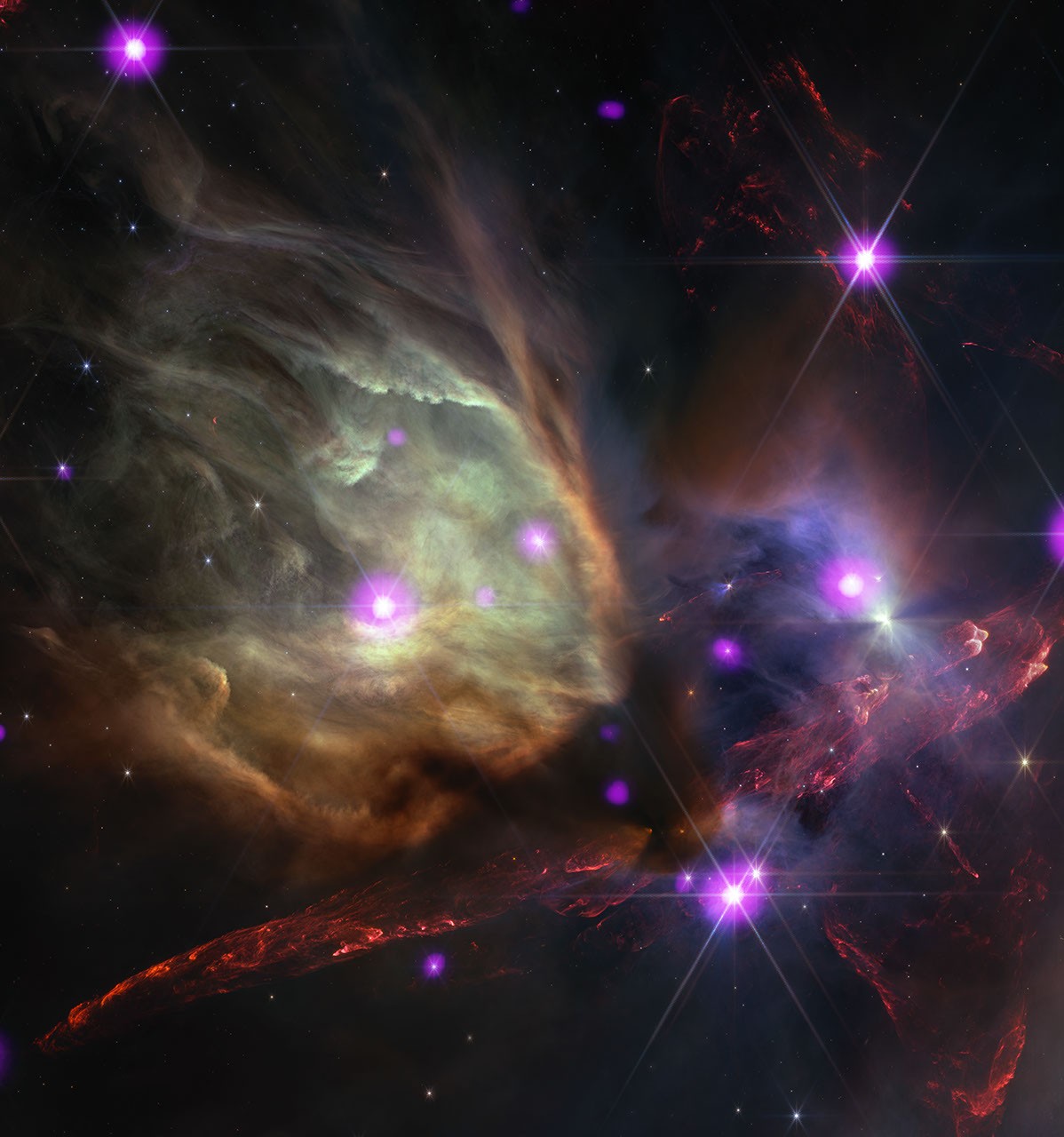
A new album from NASA’s Chandra X-ray Observatory collects snapshots of baby stars across the galaxy and beyond and transforms that data into sound.
Four new sonifications use data of stars that are actively forming, captured by Chandra and other NASA telescopes By studying places in the universe where stars are currently being born and young stars are present, astronomers can better understand the lifecycle of all stars, including our own Sun.
The galaxy Messier 82 (M82) is called a starburst galaxy because stars are forming there at a rate tens or even hundreds of times higher than in our Milky Way galaxy. This stellar birth boom may be due to a collision with another galaxy in the past. Today, Chandra sees giant plumes of hot gas that are the byproduct of young, giant stars that quickly explode and other star formation activity. One of the new sonifications combines Chandra’s data with optical data from NASA’s Hubble Space Telescope, as well as infrared views from NASA’s James Webb and retired Spitzer space telescopes. The sonification of the three types of light begins with a radar-like scan that is louder where sources are brighter. The X-ray data is mapped to the highest range of frequencies heard. Infrared data is heard as a low drone plus plucked sounds, while the optical data turns into a range of musical pitches and textures.
One of the closest and busiest star formation regions to Earth is the Orion Nebula (visible just below the belt in the Orion constellation with a small telescope and dark skies). Chandra sees more than a thousand stars in this area that are very energetic and active in their infancy. In the sonified version of the Chandra data, these stars are twinkling sounds, while the diffuse X-ray emission is mapped to pure high tones. An infrared image from NASA’s James Webb Space Telescope reveals the raw material of dust and gas used to build these new stars, and its data is heard as lower musical tones, distorted string instruments, and a digital harp.
A portion of the Carina Nebula, another star formation region, is nicknamed the “Cosmic Cliffs” because of its spectacular structure seen in infrared by NASA’s Webb. Chandra also looks at this region, seeing through the dust and gas, and detects individual baby stars – which are turned into short string sounds in the sonification. A diffuse X-ray glow throughout the region has longer strings notes assigned to it. The nebula in the Webb data is mapped to a sustained sound, punctuated by other instruments to denote features like stars and ridges.
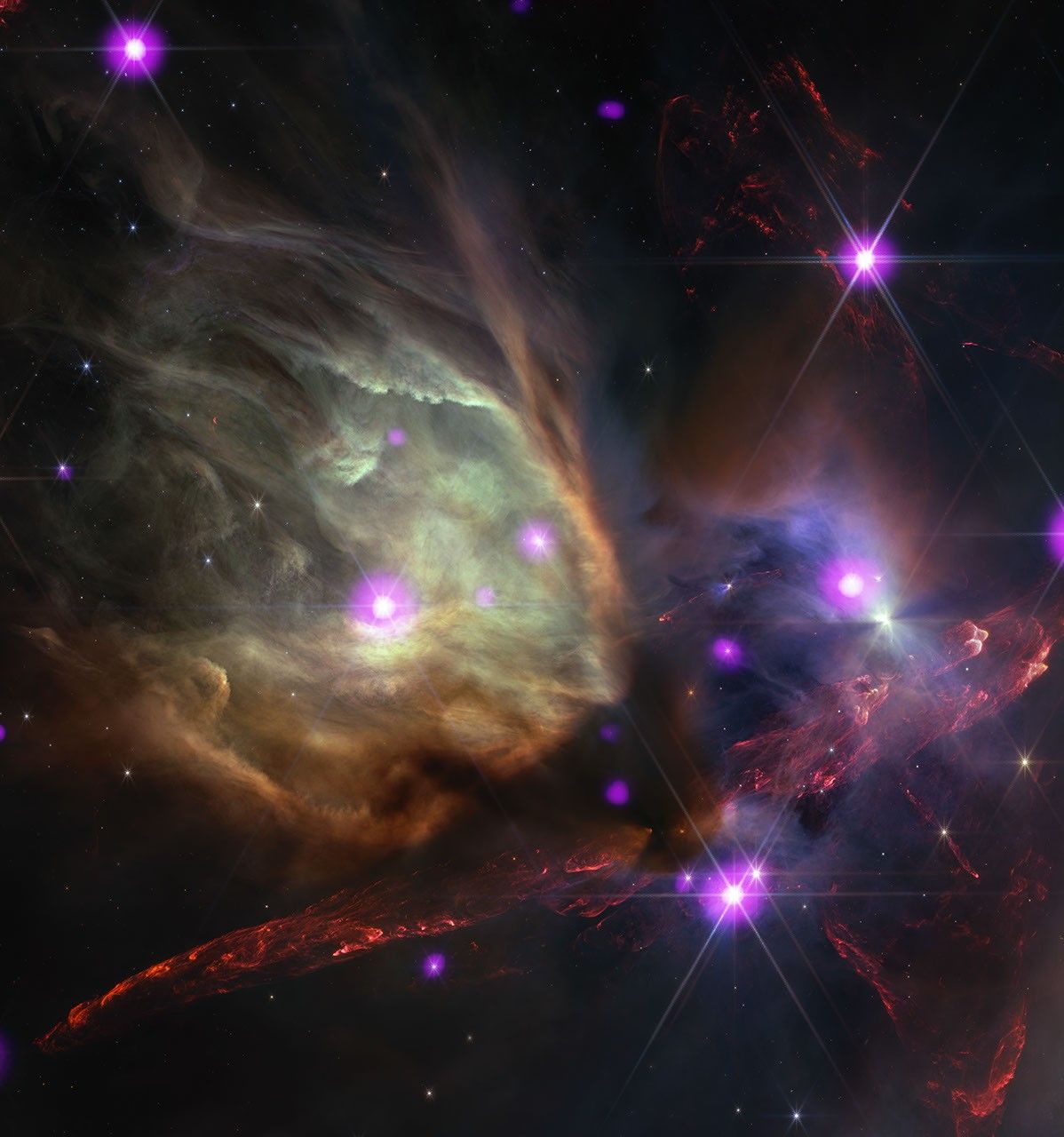
Rho Ophiuchi is a striking star-forming cloud, filled with gas and stars of different sizes and ages. Chandra reveals infant stars that violently flare and produce X-rays. Infrared data from Webb provides views of the cloud’s regions of gas and dust. When this data is made audible, Chandra’s X-rays become high-pitched glassy tones, along with other sustained sounds to mark the appearance of extended bright sources. The clouds in Webb’s infrared data are mapped as differently pitched sounds, and stars are played as metallic plucks. There is a gap in the middle of the piece due to dark dust clouds that emit very little light.
NASA's Marshall Space Flight Center in Huntsville, Alabama, manages the Chandra program. The Smithsonian Astrophysical Observatory's Chandra X-ray Center controls science operations from Cambridge, Massachusetts, and flight operations from Burlington, Massachusetts.
The sonification program is led by the Chandra X-ray Center (CXC). The collaboration was driven by visualization scientist Kimberly Arcand (CXC), Matt Russo, astrophysicist, and Andrew Santaguida, musician (SYSTEM Sounds), along with Christine Malec, consultant. More sonifications can be found at chandra.si.edu/sound.
To learn more about NASA’s Chandra, visit:
About the Author
Megan Watzke
Share
Details
Marshall Space Flight Center
Explore More
Keep Exploring
Discover More Topics From NASA
Comments 0
Leave a Reply
Your email address will not be published. Required fields are marked *
Science
Explore All
A simple metal is hiding a strange new form of magnetism
Scientists have discovered a strange form of magnetism in an ordinary-looking metal that has no overall magnetization yet profoundly changes how elect...

2,200-year-old Roman shipwreck reveals an ingenious waterproofing trick
2 hours ago
Cannabis users develop psychosis years earlier, and the gap grows with age
2 hours ago
Scientists discover a new type of depression that common antidepressants struggle to treat
2 hours agoEarth's next ice age may have already begun. Global warming stopped it
3 hours agoWhats New
View All
‘GTA 6’ Is a Birder’s Paradise

Best Early Black Friday AirPods Deals (2026)

Why is GTA 6 Getting Review Bombed?

The ‘eighth front’: Why Israel’s influence war in the US is failing

The Best Early Black Friday MacBook Deals (2026)

Now There’s a GLP-1 in Chocolate Form

Why are Russian warships off Libya, and will Ukraine’s attack change that?

GTA 6 Hacker Releases Full Xbox Build, And PC Modders Are Already Trying To Get It Running

Iraq orders takeover of oilfields in areas under Kurdish control
