
NASA Navigation Experiment Shows Promise for Planetary Landings

Armstrong Communications
NASA's Armstrong Flight Research Center
Nov 04, 2026
NASA successfully demonstrated technology designed to help spacecraft autonomously navigate to safe landing sites on the Moon and on other planets.
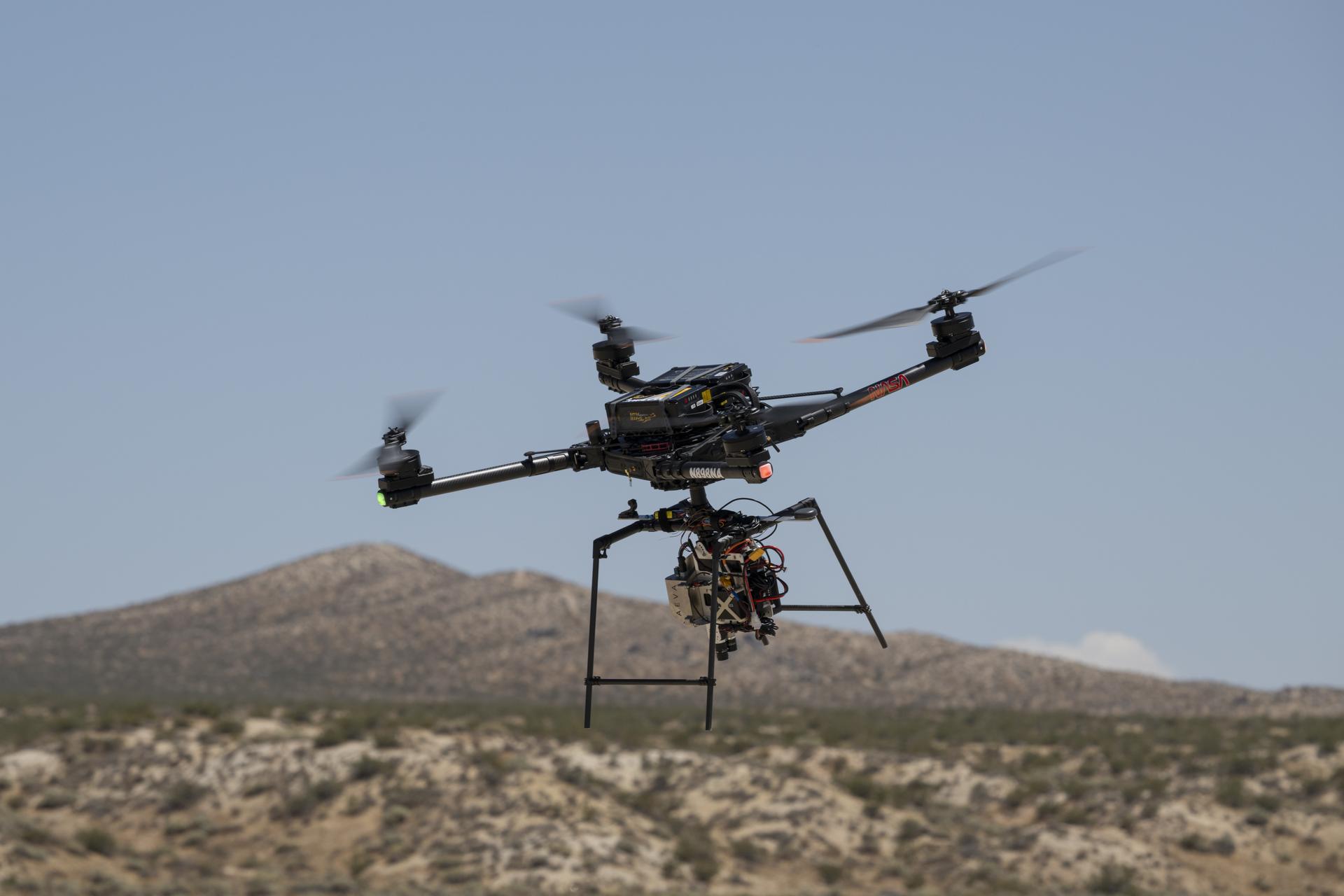
An Alta-X drone equipped with the agency’s Safe and Precise Landing – Integrated Capabilities Evolution (SPLICE) guidance, navigation, and control payload completed simulated lunar descent and landing maneuvers Aug. 27. The flight took place at Rogers Dry Lake near NASA’s Armstrong Flight Research Center in Edwards, California.
During the tests, the SPLICE payload used an advanced guidance system to map the terrain and assess potential landing areas. If the system determines the targeted landing area is unsafe, the system diverts the drone to a safer location. The system generates high-resolution digital elevation maps from light-detection and sensor data.
Researchers at NASA’s Johnson Space Center in Houston developed the SPLICE payload and partnered with specialists at NASA Armstrong to integrate, test, and fly it aboard the Alta-X drone in June and July. Those tests verified communications, data handling, telemetry, and command- control performance between the SPLICE payload and the drone to prepare for a full-scale test at Voyager Technologies in Mojave, California, later this month.
“This flight test is the culmination of almost a decade of work, for the SPLICE project,” said Davis Adams, NASA project manager. “This flight raised the technology readiness level, priming it for integration into future robotic and crewed lunar flights. Validation of the guidance and navigation systems are applicable to terrestrial, lunar, and Martian descent and landing missions.”
NASA has worked with a number of commercial lunar lander providers to implement iterations of SPLICE into their platforms. A number of the landers slated for upcoming Moon Base missions leverage data collected by NASA through the development of systems like SPLICE to execute soft touchdowns on the lunar surface.
“We are coordinating with industry regarding the usage of the guidance system once the system is available in the NASA software catalog, currently planned for this fall,” Adams said. “Some of the companies also are evaluating the system’s navigation capabilities for precision landing applications, as well as potential extensions for autonomous surface mobility.”
NASA’s Flight Opportunities project, based at NASA Armstrong, enabled flight testing of the SPLICE project early in its development that laid a foundation for it to continue advancing its technology readiness level to what it is today. Flight testing included both a descent altitude and a landing trajectory in 2019 similar to what is expected on a lunar mission and the demonstration of two NASA-developed precision landing sensor systems in 2020.
Explore More
Keep Exploring
Discover More Topics From NASA
Comments 0
Leave a Reply
Your email address will not be published. Required fields are marked *
Science
Explore All
Whats New
View All
Australian Film Festival of India Returns After COVID-19 Pause, Launches Co-Production Bootcamps as Treaty Takes Effect (EXCLUSIVE)

Don’t Bring Up AI if You Want to Enjoy Your Thanksgiving

Lisa Sthalekar Biopic, ‘Fear and Loathing in Kathmandu’ Doc and Melbourne Diaspora Comedy Series on ‘Wedding Season’ Star Pallavi Sharda’s Bodhini Studios Slate (EXCLUSIVE)

Election Deniers Despair Because Even Donald Trump Isn’t Buying What They’re Selling

Netflix’s Hit French Action Thriller ‘Elite Force’ Starring Tomer Sisley Starts Production on Season 2

AI Solved Math’s Most Famous Problem. Now Humans Are Struggling to Understand It

India-Chile Co-Production Treaty Nears Final Stage as Chilean Producers Court Indian Partners at IFFI Goa (EXCLUSIVE)

Nintendo Switch Online Just Got a Long-Awaited Update, Alongside Another GameCube Classic

Gijón Film Festival Prizes: Mads Mengel’s Debut ‘The Guest’ Wins Big as Peter Mullan and Carlos Reygadas Receive Honorary Awards
